Turbulence.

The Boeing 737 was late leaving Vancouver. Not very late – only about 15 minutes. De rigueur for many airlines, but not my beloved Alaska, who always seemed to shuttle me back and forth between L.A. and Seattle perfectly on schedule. After a glorious, eleven day vacation in the Pacific Northwest, including several days visiting family in British Columbia, I was headed back – somewhat reluctantly – to Los Angeles. I found my seat in Row 15, on the aisle, next to a pleasant, middle-aged couple that spoke with soft accents I couldn’t quite place. As I stowed my carry-on and got situated, a girl’s voice came on over the plane’s intercom. She sounded green; fumbling her words and nervously halting before announcing our destination or expected arrival time. She’s probably training, I thought, feeling bad for her.

And then came the words I seldom hear but always dread: ‘We are expecting turbulence.’ The young, inexperienced voice inspired little confidence as she informed us that the flight attendants would have to remain seated until somewhere south of Seattle, due to storms in the area. I sighed, opened up a book and tried to read, hoping I’d magically grow so immersed in it by the time we were in flight that I wouldn’t notice the bad weather. I glanced down at the ruby and diamond band on my right ring finger – my mother’s ring – and said a silent prayer.

I wasn’t always afraid to fly. As a little girl growing up in Alaska, I used to fly frequently: to Seattle to visit my grandparents, to Hawaii or Mexico on vacation with my mom and dad. Takeoff was my favorite part: the taxi down the runway and the roar of the jet engines as the plane accelerated into the sky. ‘Up, up, up and away,’ I’d say with delight, as the plane rose above the landscape and the town and roads and cars and buildings were reduced to ant-size. Even the fact that during the cold Alaska winters, planes were sometimes held on the runway in order to ‘de-ice’ the wings didn’t faze me – just par for the course being an Alaska girl. Now, I have no doubt that hearing that phrase would send terror shooting down my spine. Oh, how things change.

On this current Alaska flight from YVR to LAX, we easily soared to 10,000 feet – the approved elevation for electronic devices. False alarm, I thought, just the pilots being extra cautious. I began to relax. But somewhere on the way to 30,000 feet, the bumps began. Not too bad at first, but gradually worse. Eventually, the pilot’s voice – barely discernible over the engine noise – came over the loudspeaker: ‘Well, folks,’ he said, in a vaguely reassuring, grandfatherly tone, ‘we’ve got reports of thunderstorms from here to Portland, and the winds are moving from east to west, causing the rough air we’re experiencing. Unfortunately, we’re going to have to ask everyone to remain in their seats with seatbelts securely fastened for their safety.’

Dammit, I thought. Seeking comfort, I scanned my immediate surroundings for a friendly face. The couple next to me was sound asleep. The kind-faced, older gentleman across the aisle looked like a good prospect, but he was absorbed in his kindle and didn’t make eye contact. Envious of his calm demeanor, I reluctantly put in my ear buds and searched iTunes for the happiest, poppiest song in my library. As Ob-La-Di, Ob-La-Da by the Beatles played, I stared out the window into the cloudy grey abyss, the plane shimmying, my heart rate rising. What I wouldn’t give for a shot of whiskey – or three – right about now, but the flight attendants had to remain seated too:  no beverage service.

Calm down, I told myself, it’s just bad weather. It’ll be over soon. But the plane wouldn’t stop shaking, the visibility wouldn’t get clear, and even Paul McCartney was not helping matters. I looked down at the ring on my finger, twisted it, and asked my mom for help. ‘It’s going to be OK,’ a voice told me. ‘I won’t let anything happen to you.’ And I thought about my mother, imagined her as my angel watching over me, imagined her keeping me safe, and I twisted the ring and twisted it and twisted it. But no calm came. Just the plane, pushing through choppy air, and me, gripping my armrest for dear life and praying for it to stop.

‘Mom?’ I thought desperately. And then, with full force, a realization hit me, as powerful as the storm we were flying through, and suddenly, I was weeping, unable to stop the deluge spilling forth from my eyes. My mom wasn’t going to save me. Not today. Not ever. She never had.

My mother was my best friend, my world, the most important person in my life. I had no doubt of the fierceness of her love for me or her desire for my happiness above all else. But keeping me safe was another thing entirely. My sweet, beautiful mother had always been too fragile for this world, and from a very early age, I grew up protecting her, watching over her, and making sure she was OK. It’s what therapists call ‘parentalizing,’ which is essentially a parent/child role reversal.

From the time I was around 8 or 9, I remember filling that role. Whether I was consoling her after a bout with dad’s drinking, after harsh words from my grandmother that cut too deeply, or one of the many times that she was depressed and so very sad, I was always the one taking care of my mom.

This continued well after I left home and moved to Los Angeles. During our frequent phone conversations, I’d edit the details of my life so as not to upset her. No matter how hopeless I felt during my lowest moments as a broke, struggling twenty-something trying to make it as an actress in Hollywood, I always painted the truth with an optimistic brush. I couldn’t tell her how I really felt – desperate and alone – because I knew that she’d drive herself crazy worrying about me. The few times I tried the unedited truth, the pain it caused her always cost me more than the temporary relief provided by unloading my burdens on to the one person I wanted to confide them in. So I avoided the unedited truth at all costs, and instead I found a way to always make things OK.

And now here I was, 30,000 feet in the air somewhere over the Washington/Oregon border, exposed, vulnerable, openly weeping, gripping the armrest, praying for safety. But no one was coming to rescue me. Like so many times before, I was on my own. I’d just have to steel myself, and wait for the storm to pass.

And eventually, it did. The air smoothed out, the sun broke through the clouds. And everything was OK again. Just like it always was. But as I twisted that ruby ring, breathed a deep sigh of relief and allowed myself to sink back into my seat, I knew something fundamental: my parents were dead and gone, yes. But life circumstance had only made what was always true more apparent. As much as my parents loved me, as much as they’d supported me, I had always been my own safety, I had always been my own security, and when push came to shove, I had always relied on myself.

Ever since childhood, I had been seeking out a safe place to rest my head. But I’d only found more of what I’d already known: people who were broken – just like my mother – and needed me to take care of them. And on that Alaska Airlines flight from Vancouver to LAX, I knew that I had to change. I had to stop trying to fix the broken ones, and I had to find someplace safe outside of myself. Until I did that, I would always be gripping the armrest, hanging on for dear life. I would always be afraid to fly.

Until next time, friends.
Day Thirty One.

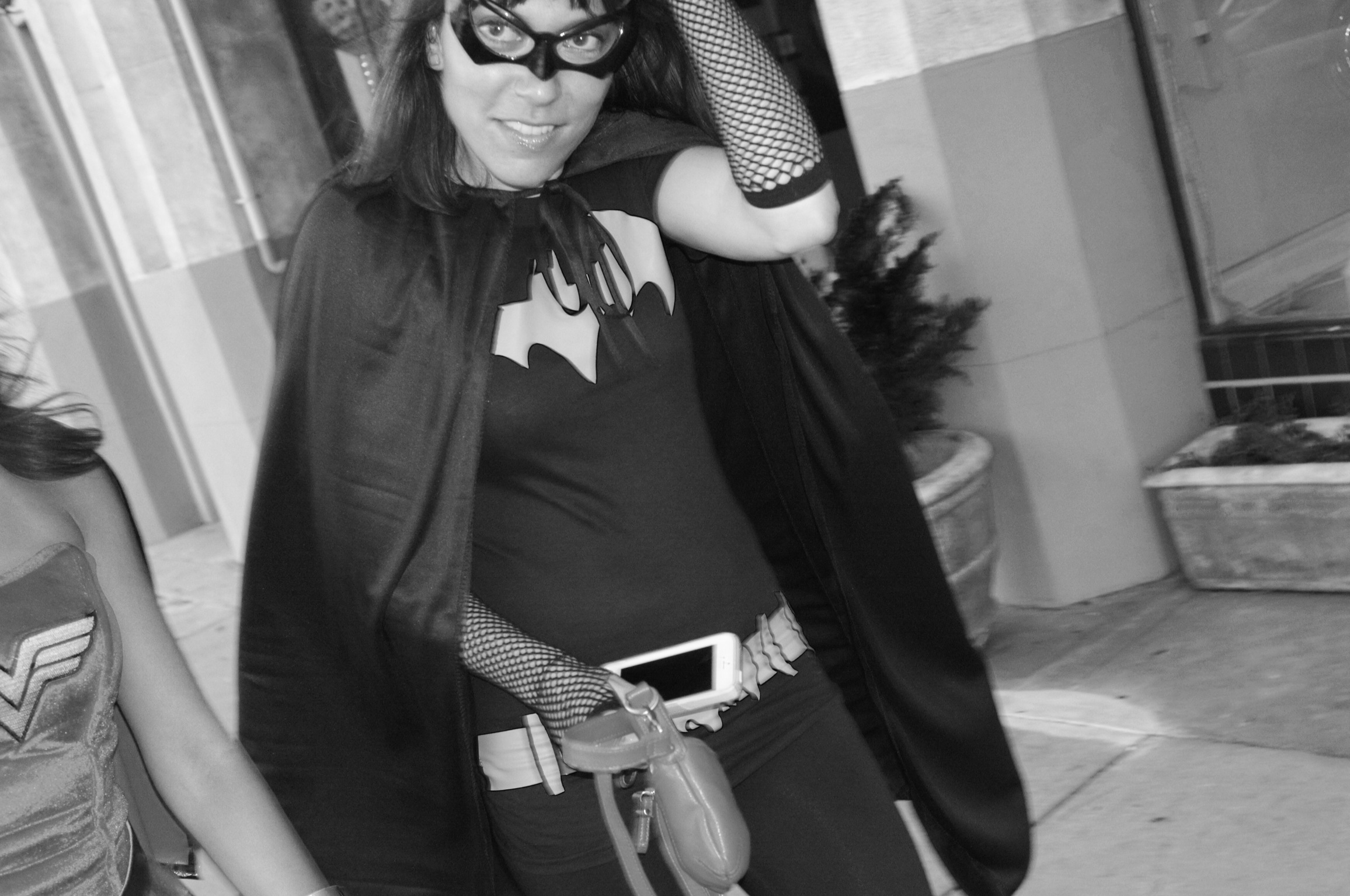
Black and White Batgirl

Well, I did it. I officially quit booze and cigarettes – cold turkey – for thirty days. It was difficult, though not nearly as difficult as I thought it was going to be. I definitely had moments where I wanted to cave, particularly when life got rough.

But, even though I’ve been feeling everything these days, my emotions didn’t overwhelm me like I thought they would. When left alone with thoughts too intense to handle, I was forced to get creative. Rather than my traditional cop out – pouring a glass of wine – I went for a run, or staged an impromptu dance party in my living room, or made a collage out of old photos, or – on one really tough day – dressed up as Batgirl and went out with Wonder Woman (thank you, Elisa) to dinner and a show on a Friday night in the heart of Los Angeles. I wouldn’t trade the interactions I had with curious strangers that night for anything.

Over the last thirty days, what I missed the most was the camaraderie that goes along with drinking, the social aspect of smoking. There was the collective tequila shot with acting class friends on a day when a tequila shot was a really, really good idea. There was the wine and gossip with girlfriends. And there was the late night philosophy that occurs while bumming a cigarette from a friend (or sitting on my patio, contemplating my future, blowing smoke into the darkness.)

But here’s what I didn’t miss. I didn’t miss worrying if I’d be OK to drive after a night out with friends. I didn’t miss starting my weekend already hung over from Friday night. And I certainly didn’t miss the bar tab. Thanks to the money I saved from abstaining from my vices for a mere thirty days, I was able to treat myself to a luxurious facial, a massage, a new dress for a friend’s wedding, and a whole bunch of new music on iTunes. Not bad.

I set lofty goals for myself to accomplish during my thirty days, which I’m sad to say, I fell short of. Most notably, I didn’t finish the first draft of my screenplay, like I had wanted. The prior-to-thirty-days-me would have beaten myself up about that, but I’m not going to. Because here’s the truth: the goal that I set in theory turned out to be way bigger than I anticipated when I put it into practice. I put in countless hours of writing – including two weekends where I essentially didn’t leave the house – and I ended up totally reworking my outline, scrapping a lot of what wasn’t working, and writing fifty new pages. As a result of my work, I’m way more excited about and committed to the story than I’ve ever been, and – while I’m a bit behind where I wanted to be – I know I’ll finish it soon because I can’t stop thinking about the characters and I can’t wait to see them achieve their (sort of) happy ending.

In the end, the most important reason for me to take this thirty-day break was to prove to myself that I could. To prove that I could navigate through a difficult time in my life in a healthy way and stick with it, despite an abundance of temptation. All the great things that came along with my detox – the money saved, the glowing, hydrated skin, the formerly tight clothes that are now loose-fitting – are just the fringe benefits of setting a goal for myself and accomplishing it. So, hooray. And now I ask myself the inevitable question that I always ask at the culmination of any project, endeavor, or challenge: what now?

Well, for right now, today, this weekend – I’m going to let my hair down. After thirty days of behaving like a schoolteacher, I’m going to have some fun. I’m going to enjoy quality time with some of my besties, I’m going to rejoice at the celebration of a dear friend’s wedding, and I’m going to get dolled up and go OUT.

And in a week, my much-anticipated summer vacation to the Pacific Northwest will finally be here. Ten days of relaxing, swimming in the sound, enjoying family time and doing what The Artist’s Way author Julia Cameron calls “filling the well” – renewing my spirit with fresh life experiences, so that when I return I’ll hit the ground running and tackle the next project (whatever that may be) with gusto.

In the meantime, who’s up for some shots?

Until next time, friends.

Thirty days.

photo

Today begins day one of my thirty-day booze-free detox. I haven’t done one of these in over two years – not since before all the very sad things started happening. To be honest, I’ve been afraid to. Throughout it all – the sickness, the never-ending stream of bad news, the deaths, the impossibly hard jobs, the rain-soaked and depressing Olympia visits – the wine or the whiskey or the martini was my reward at the end of another long day, to take the edge off, to help numb the pain. I gave myself permission to drink more than I knew I should, because my emotions were so very intense and I just needed something, anything, to feel better.

But now it’s time to take a break. I’ve come to a safer place in my life, a healthier place, and so it’s time to take away my most reliable crutch and stand on my own two feet. I need to do this for many reasons: to get healthier, to sleep better, to be more productive, to save money. And most importantly, to prove that I can.

I’m very nervous about how this is going to go. For the first time since my Mother’s death and all the deaths that followed, I’m actually sitting in my grief and processing it, rather than running from it. I’ve accepted – or more accurately, I am working toward acceptance of – my new reality, and I am actively taking steps to take charge of and improve my life. But I’m still fragile, and I’m scared that with nothing to help dull the pain, my emotions will overwhelm me. I’m feeling so much these days that the thought of sitting in these feelings alone, raw, unaided, is really frightening. What if I can’t cope? What if I fall apart? What if I cry for thirty days straight?

These fears are exactly the reason why I need to do this. This will be my opportunity to turn away from what’s easy and develop other, healthier coping mechanisms like exercise and meditation and writing. And as much as I’m fearful, I’m excited about it too.  My past alcohol-free detoxes have given way to periods of intense creativity and intense clarity, and the timing couldn’t be better because I have at least three projects in the works that demand my focus, including a very autobiographical partially-written screenplay.

To help keep me honest, I’ll be chronicling my progress over on Extra Dry Martini’s Facebook page. Just a short check in each day to let you know how the month is going.

So here’s to thirty days. Here’s to a healthier me. Here’s to taking away the crutch. And here’s to the fact that the next time I raise a glass, it will be to toast my dear friends at their wedding reception in late June, wearing a new dress paid for with money that didn’t go toward whiskey or Pinot Noir or the occasional pack of Marlboro Lights (yes, I’m giving those up too).

Here we go.

Until next time, friends.

Better.

Broken Doll B & W

It’s hard to believe it has been two years since the bottom fell out. Two years since I lost my faith in permanence. Two years since I stopped believing that all things that were good would stay good.

Two years (and a handful of days) ago, James and I said goodbye to our beloved Chow mix rescue dog Leo. He was 14 years old, blind, rail thin, his poor doggie body ravaged by cancer. It was heartbreaking to watch him waste away, and even more heartbreaking to make the decision to inject him with the syringe that would induce eternal sleep. Little did I know two years ago that was only the beginning.

A week after that sad day at the vet’s office, an innocent phone call home to wish my Mom a happy birthday – a milestone, her 60th – quickly turned strange. Mom was tense, angry, unfamiliar. She didn’t want to tell me, but I pried it out of her. Dad had cancer. It was aggressive, inoperable, terminal. Dad was going to die.

And from there, it only got worse. Bad news kept coming faster than I could absorb it. The horrifying summer in Olympia where I realized that my Mom, who’d been slipping away, was already gone. Suddenly it seemed that everyone I knew was sick. My Mom, my Dad, my Grandmother, my dear friend Rory, and of course, Leo. One by one, they all left. Died. I started calling this time in my life ‘the vortex,’ referring to the whirlpool that kept sucking me down, down, down, underwater, with no end in sight, with no hope of resurfacing.

But end it did. Finally. People stopped leaving, stopped dying. (I feel compelled to knock on every piece of wood in my house.) For a while, I just surveyed the damage, a witness to it all. Shocked, shaken, yet still standing. For a while, I was paralyzed. I’d always been a writer, but I couldn’t write. I’d always been an actress, but I couldn’t act. Words sounded funny coming out of my mouth. I couldn’t string sentences together. All the creative ways that I’d normally express myself stopped working. I was completely and utterly stuck.

Eventually, I started to get angry. Angry about what had happened, the unfairness of it all. But also, angry about my inability to do anything about it. Elisabeth Kubler-Ross, the psychiatrist whose groundbreaking book On Death and Dying introduced her theory of the five stages of grief, said, ‘Anger surfaces once you are feeling safe enough to know you will probably survive whatever comes.’ I had survived, and as I surveyed what remained of my life, I became angry. I realized I’d been living a life that was smaller than what I wanted, that I wasn’t living up to my potential, that I was making my choices out of fear. And so I started to change.

I could say that life changed me. But I don’t think that’s true. I think what’s actually true is that through painful experience, life held a mirror up to my face, to show me the person that I was supposed to be. Peering into that unyielding looking glass has, at times, been brutal. But it has also been necessary.

Two years after it all started to unravel, the pain is still fresh. Sometimes it’s too intense for words. Sometimes I hate it. But it also drives me. It drives me to write and to create and to work harder than I ever have before. With my faith in permanence gone, the urgency to say it now and do it now and feel it now is unceasing.

Two years later, I could say I’m doing better. And in many ways, that’s true. Living through and dwelling inside the most intense emotions I’ve ever experienced has made me a better writer, a better actor, and a better me. I’m sadder and I’m less sure, true. But I’m also more alive.  I’m more awake.

Two years later, I still try. I still hope. I still dream. I still experience joy. But it’s different now. It’s tougher. But so am I. And so is my resolve. My resolve to never give up.

Two years later, I wonder if I’ll ever truly feel better. And sometimes, I wonder if I’d even want to.

Until next time, friends.

The price.

For the last several months I’ve been meditating on a big idea. A vast, multi-faceted idea. An idea that can be approached from different sides and attacked from numerous angles. An idea that for me, as an artist and as a creative being, is on par with questions like ‘What is the meaning of life?’ ‘What’s my higher purpose?’ and ‘Why are we all here?’

I don’t think I can tackle the question weighing on my mind in one post. It’s too big. It will probably become a recurring theme in my work (echoes of it appear in my blog, Broken), or in a series of posts. I’m not sure yet.

But, to begin. What I’ve been puzzling over is this: in order to create great art, is suffering a necessary, and in fact, inevitable, part of the process?

Our history is rife with visionary creators who harbored broken souls. Tennessee Williams, Vincent Van Gogh, Sylvia Plath. More recently, Heath Ledger, Phillip Seymour Hoffman. The talented and tortured musicians who are members of that infamous 27 club: Jimi, Janis, Jim, Kurt, Amy.

There’s no doubt that among the gifted and the sensitive, there’s a proclivity toward addiction and self-destruction. But why? Don’t mistake me; I’m not suggesting that in order to be a great artist (or even a mediocre one), alcoholism, drug abuse, depression, even suicidal tendencies, are a prerequisite. If anything, this toxic and destructive behavior produces inertia that stands in the way of the creative process. But the idea that I keep coming back to is this: as artists, we suffer more than the rest of people. We feel things more exquisitely. In order to be visionary, we must be honest to the point that it’s painful. We must be willing to expose our most private, secret parts, our deepest vulnerabilities, and the darkest parts of our hearts. We must walk into the full range of human emotions open and unguarded.   And for that, we pay a hefty price.

I have a uniquely personal experience with the idea that the act of creation produces suffering, and it’s the reason I’ve been meditating on it at such great length. Over the last year and a half, I’ve lost three of the most important people in my life in dramatic fashion. And I lost not only their physical presence, but also something much deeper and more profound. Through their deaths, I’ve been faced with hard truths about my family that I didn’t want to know. Truths that have shaken and shattered my foundation and left me questioning everything I thought I knew: my childhood, my relationships, my history, and my very identity.

But here’s the gift. When I finally, recently, landed at zero, I became more creative. My writing got better. Ideas started clicking, and synapses started firing in a way they never had before. I found myself suddenly harnessing an authority that I’d never owned before; an authority that I’m not only compelled to share with others, but an authority that I have to share in order to survive. I know this like I know the color of my eyes or the place that I was born.

All human beings suffer. It’s inevitable. We make terrible, tragic mistakes. We experience great pain. We love deeply and we lose profoundly. Most people don’t walk into these emotions willingly. They avoid them because they’re painful, and only experience them as the inevitable by-product of being alive. But as artists, we wade into the most intense human experiences willfully, and with abandon. We welcome the pain, the joy, the agony and the ecstasy. We say bring it on. We want to feel everything. But sometimes we feel too much. Enter booze, drugs, sex, crazy, destructive behavior, in order to numb the pain. And that’s when we get into trouble.

Speaking from personal experience, it’s incredibly difficult to put my heart on the line and my grief on display in such a vulnerable way without becoming a little fucked up and unhealthy about it in the process. The intense feelings I’ve been wading into and moving through have made me feel closer to Tennessee and to Sylvia and to Vincent and to Kurt. I understand them better. My gift and my curse is that the hole in my heart is only filled through sharing my very personal story with the world. And yet to sit in those feelings without letting them swallow me whole is the great challenge that I’m still trying to sort out. The powerful conundrum that we face as artists is that our very lives depend on telling our stories – honestly, openly, nakedly, no holds barred – and yet the act of doing so is so dangerous to our psyches that it threatens our survival. It is the ultimate Catch 22, the tightrope we must all walk.

And so, my fellow poets, beautiful dreamers, dear friends, brave and broken souls, I invite you to join me in meditation on this question: how do we do what we must do, what we were born and put on this earth to do, without allowing it to destroy us?

It’s an open dialogue, if you’d like to have it.

Until next time, friends.

Nothing.

Tell me if this has happened to you before: you’re confronted with a problem that you don’t know how to solve, and so, rather than react, you wait.  And while you’re waiting, this problem magically takes care of itself.  It could be an email that you don’t know how to respond to, a request for help from a needy friend that you just don’t have time for, or a work problem that you’re not sure how to tackle.  And sometimes, as with a computer glitch, all you really need to do is turn it off for a while and leave it alone.  It’s the equivalent of shutting down and rebooting your system.

I’m the last person to advocate ignoring a problem in hopes that it will just go away.  I’m a doer.  Anybody who has worked with me on one of the plays or films I’ve produced knows that I’m about 100 miles from lazy.  It is simply not in my DNA to do nothing.

But sometimes in life, it’s important to take a beat.  Sometimes waiting and letting the dust settle is the only thing that can be done.  Sometimes, inaction is the best course of action.

Since I’ve become the girl who writes about very sad things – don’t blame me, blame the cosmic forces at work in shaping my life’s trajectory over the last twenty-four months – allow me relate the power of doing nothing back to another very sad thing.

When my Dad was diagnosed with stage four pancreatic and liver cancer in the spring of 2012, he decided that the best course of action was to do nothing.  The tumors in his liver numbered at least ten – too many to operate successfully – and the pancreatic tumor he had was so rare that the only chemo drug available was brand new to the market, experimental at best, and wouldn’t eradicate the tumor.  In short, there was no cure.  His only treatment option might buy him some time, but it could also make him very sick.  Why add more years to your life, if the life in your years was full of vomiting, pain and misery?

Dad, ever the pragmatist, opted to let his life run its inevitable course.  He figured that at 81, he’d lived a good life and he was going out on his terms.  Plus, any chemo meant that he would have to stop drinking, and there was no way the Irish rascal was giving up his booze, especially not with a looming expiration date.  As Dad’s internist said when his diagnosis came down, ‘If I had your prognosis, Bernie, I’d buy a one-way ticket to a Caribbean island, park myself on the beach with a tropical drink in hand, and lie in the sun until my time was up.’

I thought my Dad’s decision was brave, and it was the one I would have made had I been faced with the same set of circumstances.  My Mom, on the other hand, couldn’t accept it.  I had numerous conversations with her in which I laid out all of the facts on the ground and explained how all reason and logic necessitated that this was the only way to proceed.  And after all, it was Dad’s decision, and we had to respect his wishes.  But no amount of reasoning or logic ever got through to my Mother.  She became obsessed with the idea that this experimental, unproven, non-cure of a drug might work, or that there had to be something else, some unseen solution, something no doctor had ever heard of that just might be a miracle cure.

Accepting that there is nothing that you can do when someone you love is going to die is probably the toughest form of acceptance there is.  There’s a reason why there are five stages of grief and acceptance is the last one.  It is not an easy road to get there.  But as I reflect on the way that my Mom obsessed on Dad’s decision – to the point of making herself literally insane – and how that obsession exacerbated her own addictions and the numerous issues she was already battling, I can’t help but see her behavior as a cautionary tale.

I am my Mother’s daughter.  I am anxious like her and I worry like her and I make endless to-do lists and I lose sleep over the contents of those to-do lists.  I would always, always, rather do something than do nothing.  But, I am trying to learn to be OK with the fact that sometimes there’s nothing to be done.

I can be impulsive and a bit rash (blame the stars, I’m a Sagittarius).  Often, I try too hard and do too much and in doing so, I can turn a situation that’s just fine on its own into a mess.  I am impatient, and frequently just want to get on with it.  But there’s an art to knowing when to act and knowing when to let it be.  When to do something and when to do nothing.  When to take a breath, and relax and let life take care of itself.  And to realize that sometimes, time is the only thing that heals.

Until next time, friends.

The gift.

A recurring theme in my life these days seems to be the idea that good can come from bad, that great beauty can be born from great adversity, that even the most oppressive rain clouds possess their silver lining, if you’d only look for it.  Several days ago when I was having a particularly tough day, I returned to a poem called Roll the Dice by Charles Bukowski.  It was introduced to me several years ago by my friend Barbara and I’ve leaned on it many times over the years when I’ve needed a lift (If you’d like to read it, it’s pasted below, at the bottom of this blog).  The poem is about dedicating yourself to your passion and being so committed to it that you’re willing to suffer through any hardship in order to make it happen.  A couple lines in particular stand out:  Isolation is the gift.  All the others are a test of your endurance, of how much you really want to do it.

Isolation is the gift.  It’s tough to be alone.  It’s more fun to be with other people, to be social.  But it’s also a distraction.  My acting teacher said something in class a few weeks ago and I wrote it down because it really hit home.  Anyone who’s trying to do something wonderful will suffer in loneliness.  He was talking about artists – actors in particular – and the art of creation.  But I think it’s true for most people. As much as we are social beings, we need time on our own.  To do our work.  To figure out who we really are without the opinions of others reflecting back upon us like mirrors.

I have a complicated relationship with my aloneness. I hate it because it makes me feel just that:  lonely.  But I also need it.  There was so much to do after my mother’s death, that I didn’t have time to grieve.  My dad was ill and he was alone.  My grandmother was ill.  Bad things kept happening and crisis management stretched on for months.  And after both my dad and grandmother passed, I threw myself into work, co-producing a play festival and a film, and just keeping so, so busy.

At the time, I think being busy and distracted was what I needed to do.  I had to keep moving in order to get through.  But now – finally – I’ve arrived at the place where in order to get better and to heal, I have to sit with myself and let the feelings land where they land.  No one else can do that for me.  No one can grow for me, or process my emotions for me, or get healthy for me, or make the changes I need to make for me.  That’s my job.  And like it or not, it’s a path I’ve got to walk alone.

It feels paradoxical to say that because throughout all the tough stuff, I’ve been surrounded by wonderful, loving people who’ve buoyed me up, who’ve supported me, and without whom I never would have survived the darkest of the dark.  I don’t want to slight them or diminish their crucial importance in my life.  I’m eternally grateful for every helping hand and kind word.  But now I’ve got to scour the depths of my soul for what’s next and the only one who can do that is yours truly.

We don’t walk into the great unknown willingly because change is uncomfortable and, at times, terrifying.  But life, through circumstance, will drive us to change.  It pushes us to be better when we won’t do it on our own.  It shakes us up when we need to be shaken; it creates obstacles that we must overcome, so that we can surprise ourselves with our resourcefulness and stand in our own strength.  ‘What doesn’t kill you makes you stronger,’ has become such a cliché I almost hate to type it on the page, but clichés are anchored in our vernacular for a reason:  they’re true.

I’ve survived a lot of traumatic life events over the last two years, but I’m starting to see the gift in what has happened to me.  It’s tough to admit that because it almost sounds like I’m grateful for the bad stuff, or that I somehow wanted it to happen.  I’m not, and I didn’t.  But I’m grateful for what it has taught me, for what it is teaching me.  I’m grateful for the ability to look at my life through different, wiser (and yes, sadder) eyes and appreciate how truly beautiful it is, and what a gift I have indeed been given.

Isolation is the gift.  For me, right now, it is.  I’m surrounded by amazing people who love me and whom I love back.  I’m lucky.  But – at least for the time being – I’m on a path that, on a fundamental level, I must walk alone.  To grow.  To explore.  To write and to do my work.  And to just come home.  To me.

Until next time, friends.

Roll the Dice by Charles Bukowski:

If you’re going to try, go all the way.

Otherwise, don’t even start.

This could mean losing girlfriends, wives, relatives and maybe even your mind.

It could mean not eating for three or four days.

It could mean freezing on a park bench.

It could mean jail.  It could mean derision.  It could mean mockery — isolation.

Isolation is the gift.

All the others are a test of your endurance, of how much you really want to do it.

And, you’ll do it, despite rejection and the worst odds.

And it will be better than anything else you can imagine.

If you’re going to try, go all the way.

There is no other feeling like that.

You will be alone with the gods, and the nights will flame with fire.

You will ride life straight to perfect laughter.

It’s the only good fight there is.

Blog at WordPress.com.