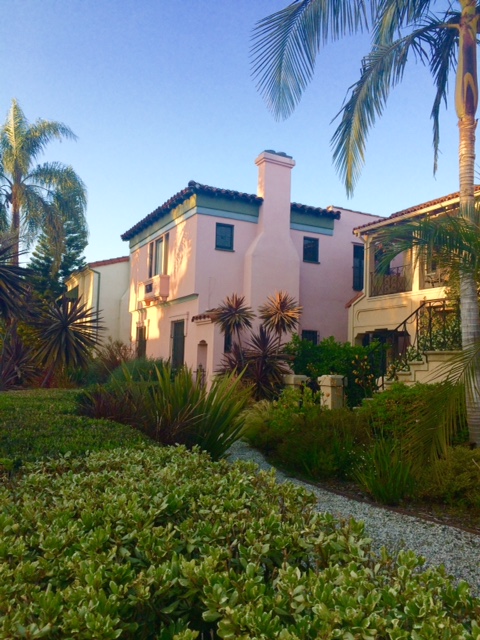
Thirty-five.

On December 2nd, I marked a milestone birthday: thirty-five. Perhaps it’s fitting then, that this entry also signifies another milestone: my 100th post on Extra Dry Martini.
Bare Feet

Normally, I love birthdays (both my own and other people’s), but this one felt less celebratory and more like staring down the barrel of a gun. Thirty-five? Shouldn’t I have it all figured out by now? Shouldn’t I own a home, have a family, be navigating the ladder of success on my way toward building a lucrative career? Numbers don’t lie, and based on my age, there’s no denying that I am officially a grown up. So why aren’t I acting like one?

Though these (judgmental) thoughts danced across my brain, the truth is, when the day arrived, I was too exhausted to be as hard on myself as my inner critic demanded. I was fresh off the recent experience of seeing my beloved grandfather through hospice (which I documented here, here and here), and after spending the better part of a month camped out in a small town in rainy Washington state, I returned to Los Angeles only to be confronted with another piece of life-shaking news. While I’m not ready to share this latest development publicly (I will, probably in my next post), suffice it to say I find myself at a significant crossroads, with two very different paths to choose from. Whichever decision I make means big change, and the only way for me to know which road to follow is to look within my own heart and ask myself what I want.

Hotel Palms

The Friday after my birthday, I did what I often do when I’m feeling lost: I went to the ocean. I packed a journal, my birthday cards, a tattered copy of Anne Morrow Lindbergh’s A Gift from the Sea, and drove south. Needing to decompress from an intensely emotional couple of months, I decided to spoil myself and reserved an oceanfront hotel room at the stunning Surf & Sand Resort in Laguna Beach, CA.

I expected the resort to be luxurious, but the property exceeded my every expectation. Upon checking in, I was greeted by an expansive guest room appointed in crisp whites and soft sandy neutrals, a bottle of sparkling water chilling on ice, an artfully arranged fruit and cheese platter, and a handwritten note of welcome from the hotel staff. I opened the white shutter balcony doors to a breath-halting view of the sunset over the Pacific. I cracked open a bottle of birthday wine, collapsed onto the enormous King Size bed, and fell asleep to the sound of waves crashing outside.

It took a full twenty-four hours for my tired brain to stop racing, and to allow my internal rhythms to slow down and mimic the pace of the ocean. I went for long walks along Pacific Coast Highway, enjoyed delicious meals, and savored the sight of the sun slipping below the horizon, streaking the topaz sky with tangerine fire.
Waves

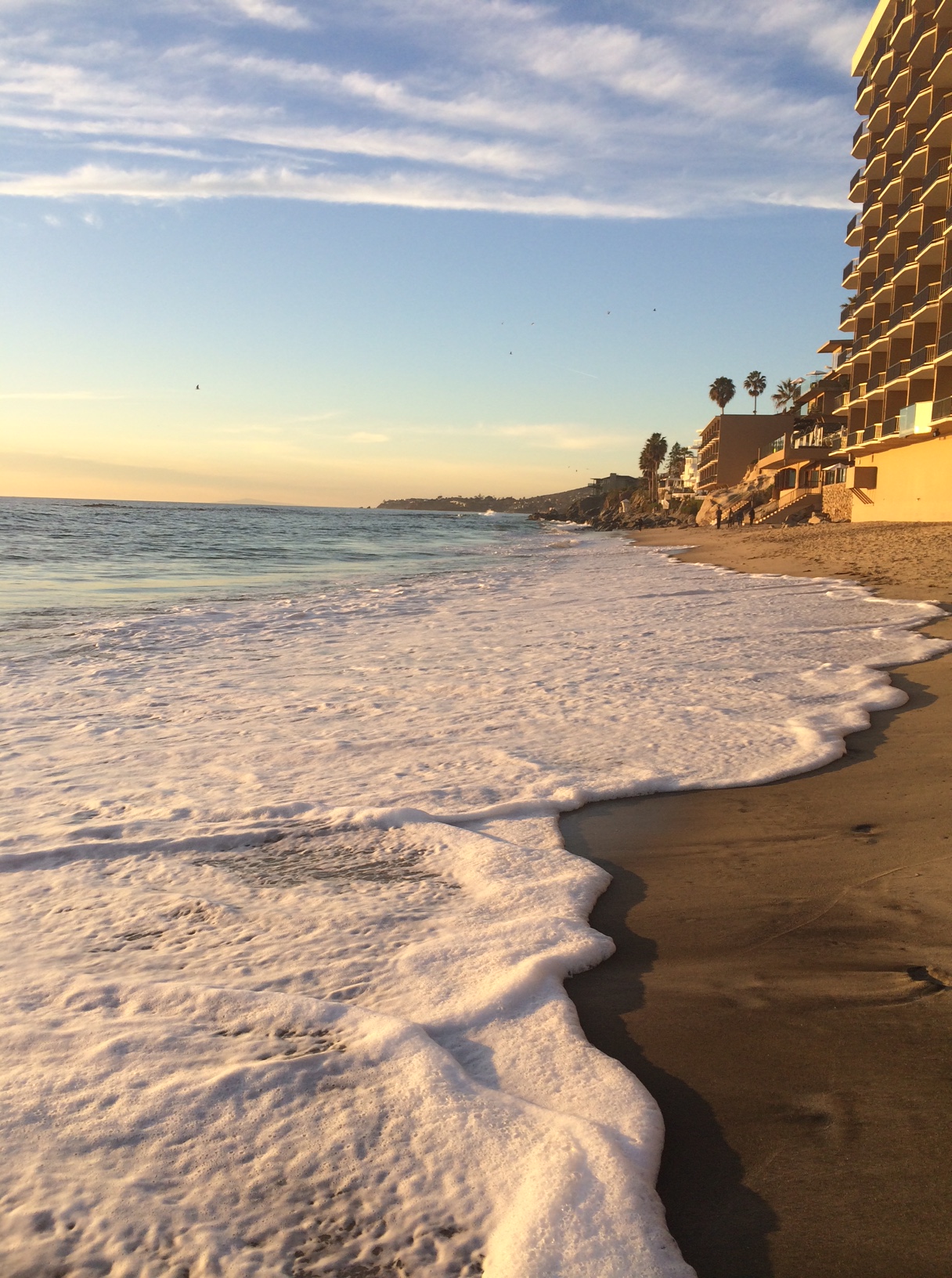
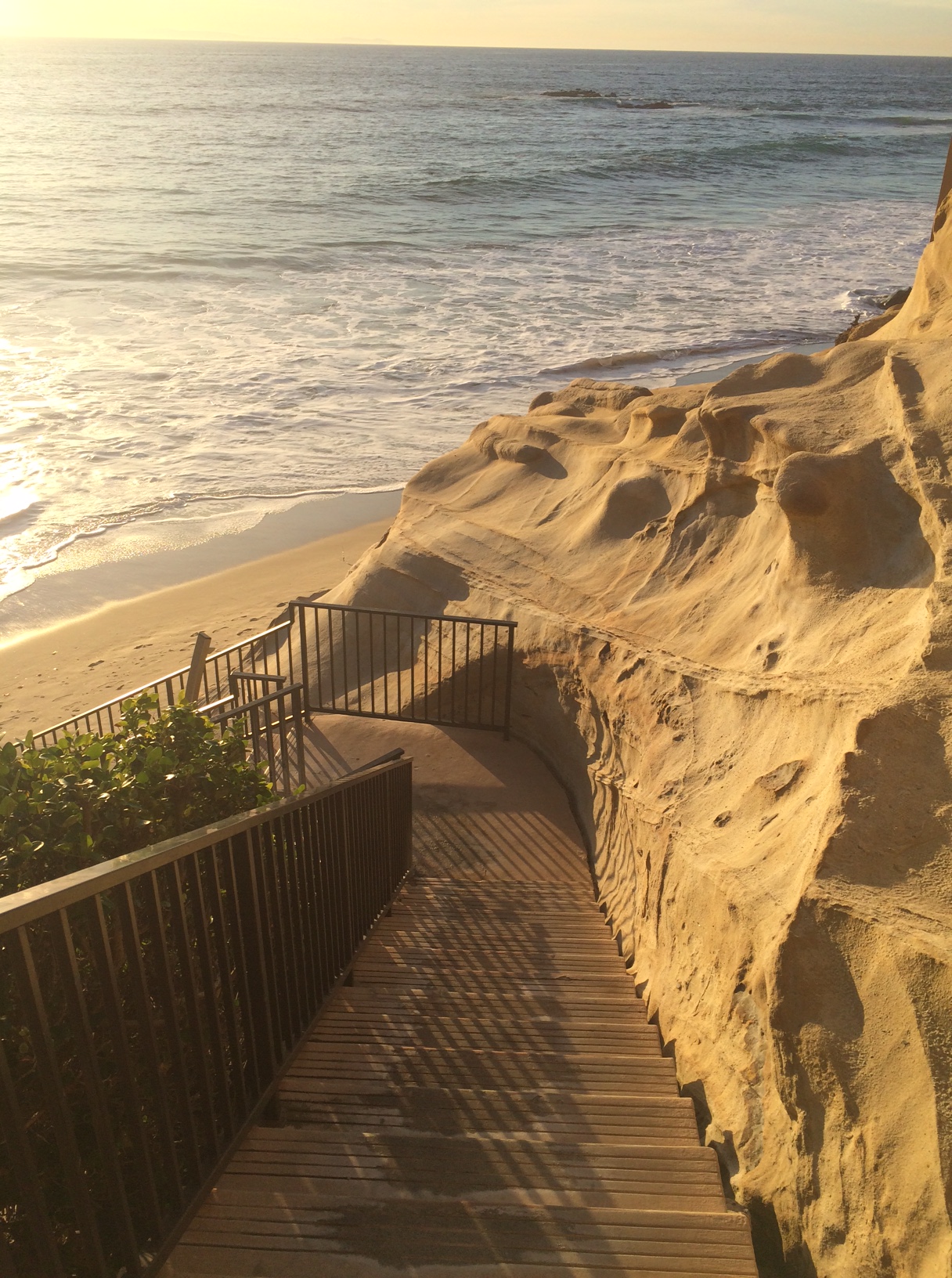
On my last day in Laguna, I lounged in the afternoon sun and swam lazy laps in the warm saltwater pool. An hour before sunset, I made my way down to the beach. Running in and out of the surf, I laughed as the tide quickly receded then rushed back, swallowing my bare feet with a force as the not-quite-cold foamy white waves tickled my toes.

My whole life, the ocean has always held a certain mysterious allure. In the presence of its seemingly infinite expanse I am small, but not in a way that renders me insignificant. Instead, my tiny-ness thrills me, reminding me that my problems are a mere droplet compared to such a mighty sea. As the roar of the surf matches the drumbeat of my own heart, I know that I am part of the earth – all of it – and my connectedness to such great beauty makes me feel both awestruck and safe.

The first four years of my thirtieth decade brought challenges I never thought I’d face. Not this young, not this soon. These years have brought death and unimaginable heartbreak and a loneliness I feared I’d never find the bottom of. But they also brought strength, and resilience, and gratitude, and a deeper knowledge of love than I’ve ever known. I am often sad and fragile, but I am also wise, and tenacious, and alive.

Palms and Sea

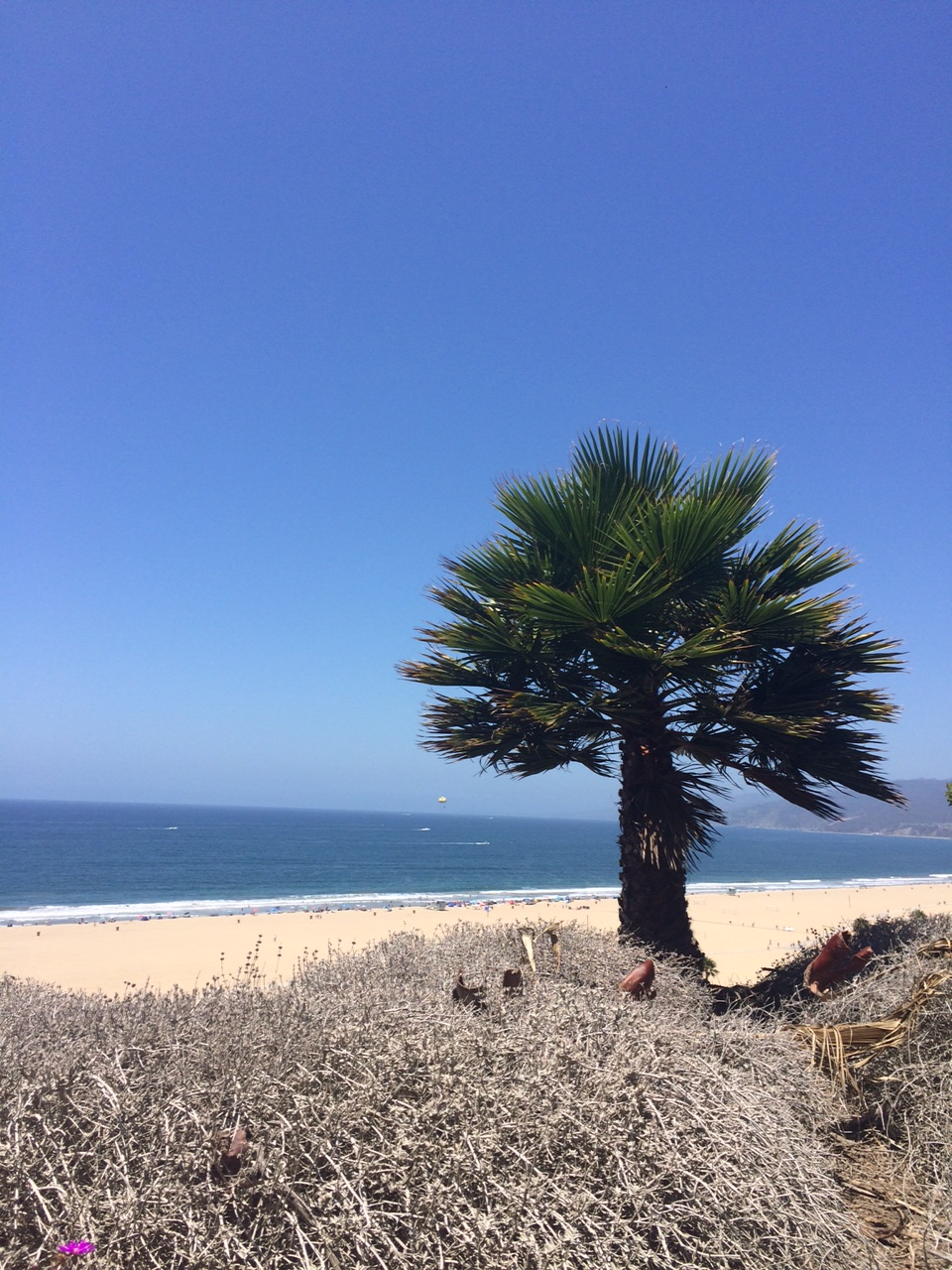
A few days after my thirty-fifth birthday, I stared out at the Pacific, wondering how I could go on, now that the four people who had most shaped my life were no longer here. As I thought about them, images of other people appeared in my mind – both family and friends – who had stepped in to fill the void in the absence of those four. A cherished bunch who had laughed and cried with me, who had embraced me with kindness, who had counseled me through hardship, who had held me up when I feared I would collapse. And in that moment of quiet reflection, I knew unquestionably not only that I could go on, but that I would.

When I left Laguna, a piece of my heart stayed behind. I vowed to return after questions had been answered, decisions had been made, and challenges were met, head on. As Anne Morrow Lindbergh wrote in that well-worn book I carried along with me on my journey: “Patience – Faith – Openness, is what the sea has to teach. Simplicity – Solitude – Intermittency . . . But there are other beaches to explore. There are more shells to find. This is only the beginning.”

Until next time, friends.
Stairs

Limbo.

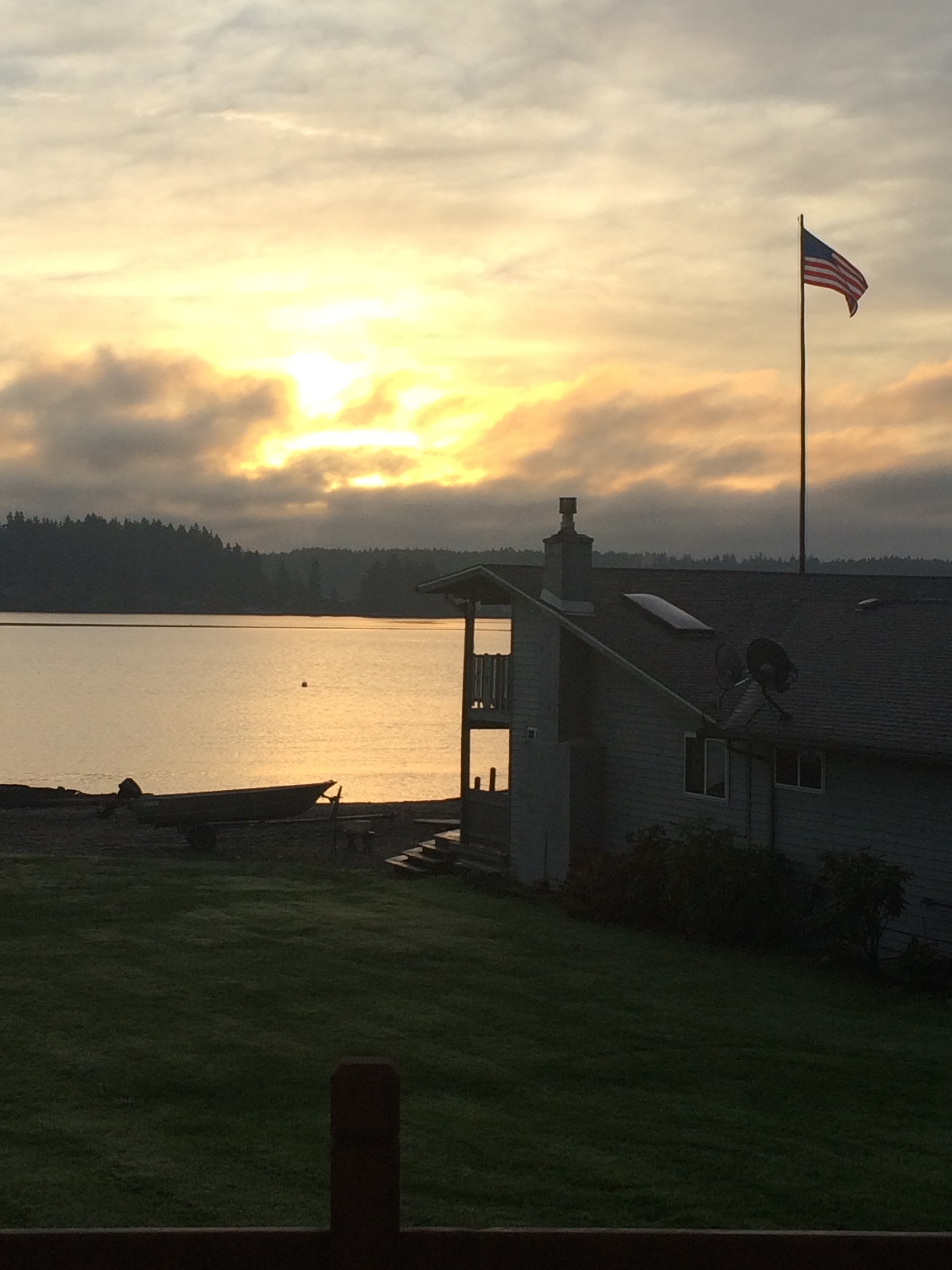
Grandpa sits in his usual spot in the living room, staring out the picture window at the placid, silvery surface of Case Inlet, framed by evergreens that have turned an early November shade of amber. His yellow-tinged eyes reflect the vacant gaze of someone who’s looking but not seeing. “What are you thinking about?” I ask, patting him on the shoulder. I expect his typical response: “Nothing.” Instead, he intones softly, “I’m thinking about how quickly the time has gone.”

I’ve been at the beach for fifteen days, though of course, that’s not the measure of time that Grandpa is referring to. This evening, barring a catastrophe, I will leave, and board a plane headed back to Los Angeles. It is staggering to me that my time here has passed so swiftly, and yet, has contained so much within its rapidly elapsing days. I feel as though I’ve been moving in slow motion for weeks, traveling from joy to despair to fear in the space of a single hour, sometimes in a single minute. There is always another hospice appointment, another phone call, another email, another problem, another difficult conversation. And in between it all, I’ve been working, straddling two worlds – here and there – with the aid of an unreliable Wi-Fi connection.

I’ve never been very good at living in the moment, but these last couple weeks, the moment is all I’ve had. It’s no wonder my sense of time is so screwy, with Grandpa’s feeling borrowed and mine suspended. What a strange sort of limbo it is to sit with someone you love as they face the end of their life. The question that looms before us is when? It is the question he asks of everyone: his caregivers, the hospice nurses, the chaplain, the social worker, and of course, his family. It is the question that no one has the answer to, least of all me.

IMG_5702

I am prepared for what’s coming in a way that I wasn’t able to be with either of my parents, and for that I am grateful. I am grateful for all of the time I’ve been able to spend with him. But after fifteen days, there is little for me to do but wait.

Twenty-four-hour care is in place; contingency plans have been made. And the look Grandpa now sees reflected back in my eyes is one of someone who’s watching his every move, searching his face for signs of what’s to come. I can’t do this any longer. I can no longer sit around this rain-soaked place – beautiful as it is – waiting for my 89-year-old Grandfather to die.

I feel selfish for craving a way out, for craving warmth and palm trees and cheap, delicious Mexican food, and a hike in the hills and the sight of the Pacific and a desperately needed session with my therapist, but I do. I crave all of these things. I even crave the to-do list that awaits me upon my return, because it represents routine, and the opportunity to pretend, for a little while, that everything is normal.

So back I will go, for now. My return to the beach is already booked, but every ticket is refundable, every plan changeable. This type of freedom, it turns out, is expensive. But it’s the price you pay when you’re in limbo. When you’re left with nothing to do but wait.

photo 1


The beach.

If only you’d have known me before the accident/

For with that grand collision came a grave consequence/

Receptors overloaded, they burst and disconnect/

‘Til there was little feeling, please work with what is left.

IMG_4960

I’m running along Grapeview Loop Road in the sleepy Western Washington town of Allyn. It’s Friday afternoon and the rain that has been falling steadily all morning has let up, topaz blue skies peeking through the still stormy, not-quite-white cotton candy clouds. It’s what people in the Pacific Northwest call a “sun break,” and I’m taking full advantage of it. Rain is usually an unwelcome sight in this part of the world during the late summer months, but it’s desperately needed due to abnormally dry weather conditions and a series of terrible fires that are pummeling the Eastern side of the state. For me, the rain also offers a welcome respite from the 100-degree temperatures currently baking Southern California, where I live. As I imagine the wall of heat permeating my little stucco bungalow in West Los Angeles, I am grateful that I’m here and not there.

As I wave appreciatively at the motorists who drift toward the median, giving me the widest possible berth as I jog by on the shoulder, I savor the delicious irony of the Death Cab for Cutie song, The Ghosts of Beverly Drive, pulsating through my headphones. It’s a song about damaged and jaded people in Los Angeles, people with “no firsts anymore.”

I don’t know why, I don’t know why/

I return to the scenes of these crimes/

Where the hedgerows slowly wind/

Through the ghosts of Beverly Drive.

While I don’t consider myself to be damaged or jaded by Los Angeles, after sixteen years of living there, I understand where those lyrics come from. Over the last decade and a half, I’ve changed dramatically from the eighteen-year-old college student who first arrived there, bright-eyed and full of hope. It took me years to get to where I am now, living a life that actually fits me, rather than trying too hard to be someone I’m not in a desperate effort to impress other people or feel worthy of their attention.

And yet. Despite the fact that I have greater ownership over my life than I’ve ever had, L.A. still doesn’t feel like home. It never really has. Not in the way that this place does: the place where I’m currently jogging down the road.

IMG_4995

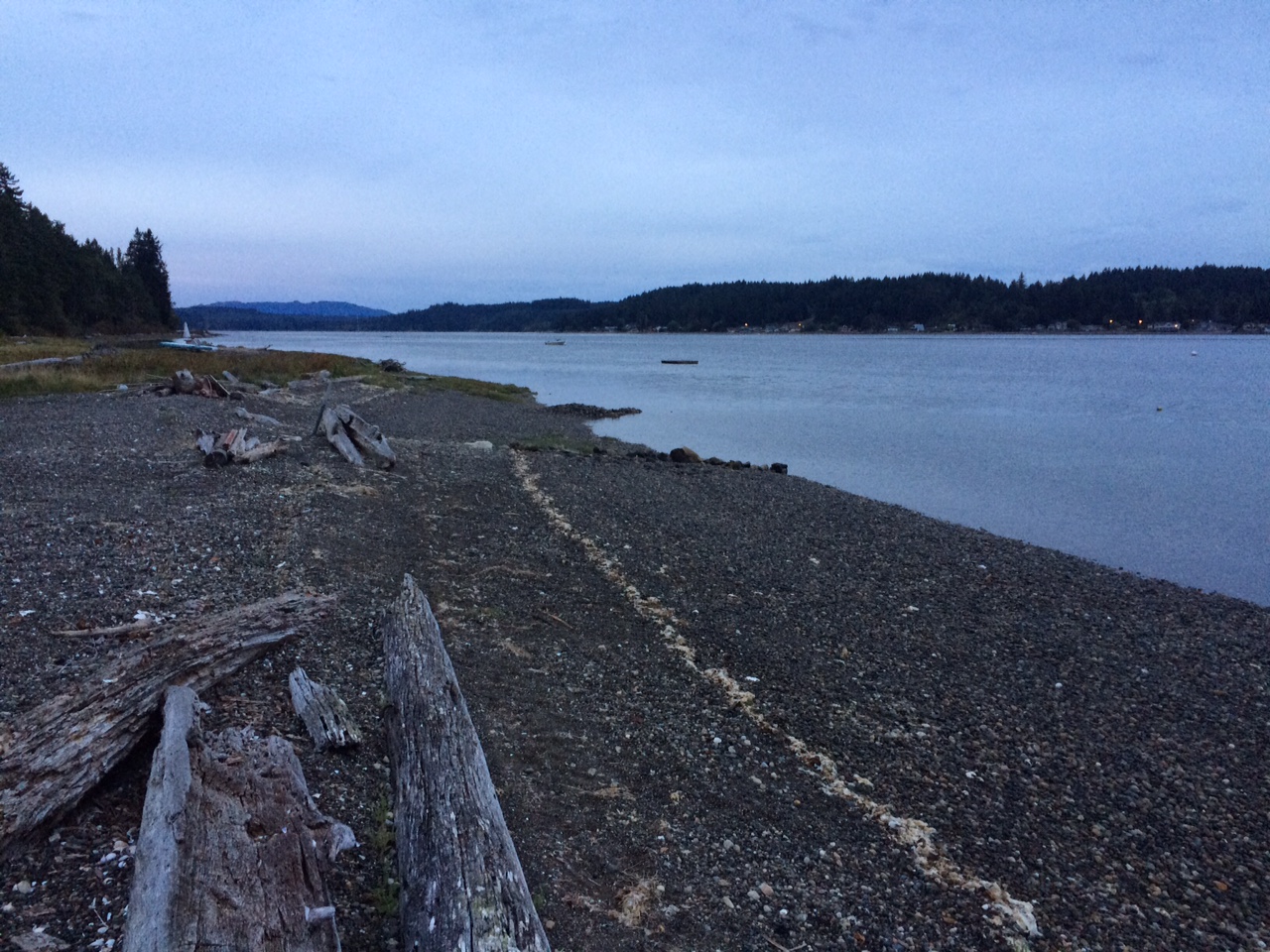
For just over a week, I’ve been staying in Allyn, in an area of the Pacific Northwest that my family simply calls, “the beach.” It’s a large parcel of waterfront land overlooking Case Inlet, a piece of property first purchased by my grandparents in 1959, when they were court reporters working in Seattle and looking for a place to build a summer home.

As a child, I remember the beach as nothing short of magical. It was far away from everything, tucked away at the edge of the world like some sort of family secret. I spent all of my summers there: foraging for driftwood to build great big bonfires, roasting s’mores under the starlight, digging for clams at low tide (still the best clams you’ve ever tasted), cruising around Case Inlet in my uncle’s boat, dogpaddling through the saltwater and dodging big scary jellyfish.

As I got older, the magic began to fade as reality set in. My first cousin, who was, for many years, the closest thing I had to a brother, turned to drugs and violence and severed all ties with our family. My once vital and full-of-life grandfather suffered a stroke, leaving him wheelchair-bound and depressed. My dad was diagnosed with stage-four pancreatic cancer, but my mother shocked everyone by dying first, just a few months before him. My maternal grandmother quickly followed suit, succumbing to Alzheimer’s disease that had gone undiagnosed for years.

It got to the point where I started to hate the beach, because every visit was a painful reminder that so many people I loved had been so abruptly ripped away. Memories of carefree childhood summers were replaced with harsh adult realities like probate court, property tax, and estate planning. The left turn off of Grapeview Loop Road and on to our property – with its still, serene view of Mt. Rainier rising above Case Inlet – no longer made my heart swell. It leveled me.

IMG_4938

It took some time, many return visits, and no small amount of healing to realize that in spite of all of the change and loss, the beach is deeply rooted in my DNA. Not long ago, among a box full of mementos, I found a letter that my grandfather wrote me upon my college graduation, just over a decade ago. I was about to embark on my new, exciting life as an adult in Los Angeles, and he sweetly implored me not to forget where I came from. He closed the letter with these words: The beach never changes, ‘tis only we who change.

He’s right. I have changed. We all have. But as life shapes and shifts around me, the beach remains a constant. During these last three years of navigating emotional chaos and loss and questioning my life choices, years where I’ve slept with one eye open due to nightmares and panic attacks and occasionally crippling anxiety, the beach is the only place where I’ve continued to feel sheltered and safe. It’s the only place where I’ve been able to submit to deep grief and let it wash over me, allowing the healing process to begin. It’s the only place where my equilibrium returns, and where I’ve often thought – sometimes in spite of all evidence to the contrary – that everything is going to be OK.

It’s ironic to think that it took my mother dying for me to understand why she loved this place so much. Why it was always, throughout her life, her True North. Why she insisted, as far back as I can remember, that her ashes be scattered here, so that she could forever be a part of the sea and the sky and the evergreen trees. The other day, as I swam in Case Inlet, feeling the tingle of saltwater in my mouth, with the air perfectly still and everything around me slowing down, I whispered aloud, almost as though it were a prayer: I get it, Mom. And I wonder if somehow she heard me. I wonder if somehow she knew.

The beach never changes, ‘tis only we who change.

Until next time, friends.

IMG_4997

The end of a thing.

This past weekend, I closed another show. It had been a while since I’d been on stage – two years – and I hadn’t realized how much I’d missed it: the energy in the dressing room as the clock ticked toward curtain, the palpable excitement in those few, electric moments after “places” are called, waiting in the dark until it’s time to go on. The rush of adrenaline flooding my body when a cue line was dropped, and the sweet relief of recovery when the scene righted itself and moved forward. The utter you-can-hear-a-pin-drop silence when I realized the audience was right there with me, waiting, hanging on every word.

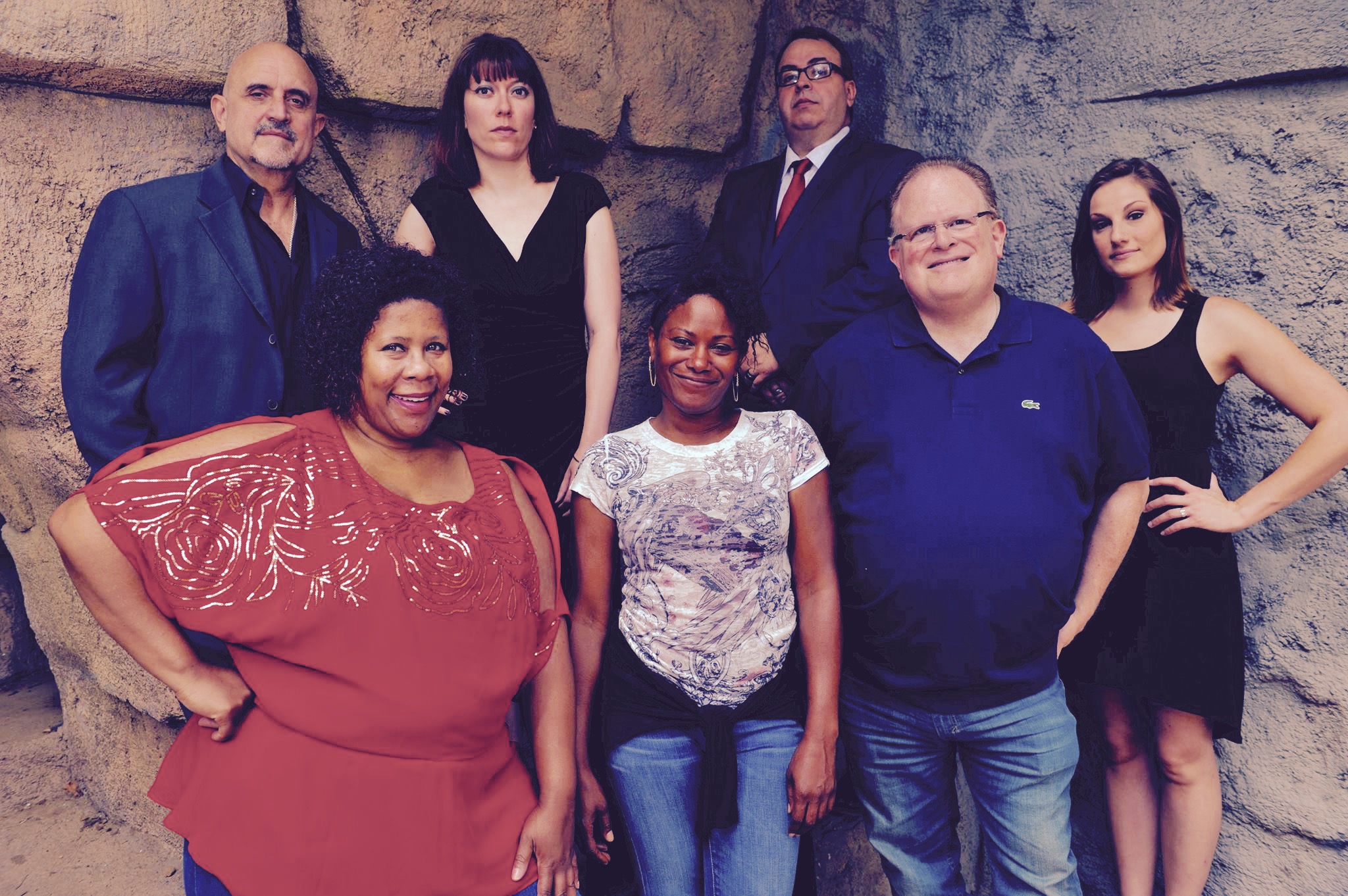
This play, Bare Naked Angels, was markedly different than any other play I’d done before. Autobiographical in nature, more solo performance than ensemble (though, really, a hybrid of both), it featured raw, personal stories from my and the six other cast members’ lives. It was the first time I’d produced a show without reading a script before signing on (our final script wasn’t ready until three weeks before opening night), and I had only a rough idea of the show’s concept and the journey it would take me on when I began.

During the months of workshopping that led up to Bare Naked Angels’ performance dates, my life was hit with a series of jolting events – both good and bad. The closer we got to opening night, the more change swirled in the air around me. It was almost as if by saying yes to this experience, with its leap-without-a-net nature, the universe began to demand more from me. I imagined Madam Universe needling me, saying something like, “Hey kid, don’t think I haven’t noticed what you’ve been doing. Complacency is no longer an option. And if you don’t take action on your own, I’m going to push you into it.”

Push me, she has.  These last few months, my insides have been shifting, a shift that has been echoed in the world around me. I’m not quite sure how to reconcile all I’ve seen and felt and experienced, or how to process what it all means. And to be honest, I haven’t had the time, at least not yet. In the days since the show closed, I have been preparing for an impending office move that will happen while I’m out of town. That’s right – more change – the company I’ve worked at for the last decade is being evicted from our office park, and I’ve been packing up my desk, cleaning, purging, organizing, and attempting to catalogue and archive fifteen years worth of a brand’s history; a history that is inevitably intertwined with my own.

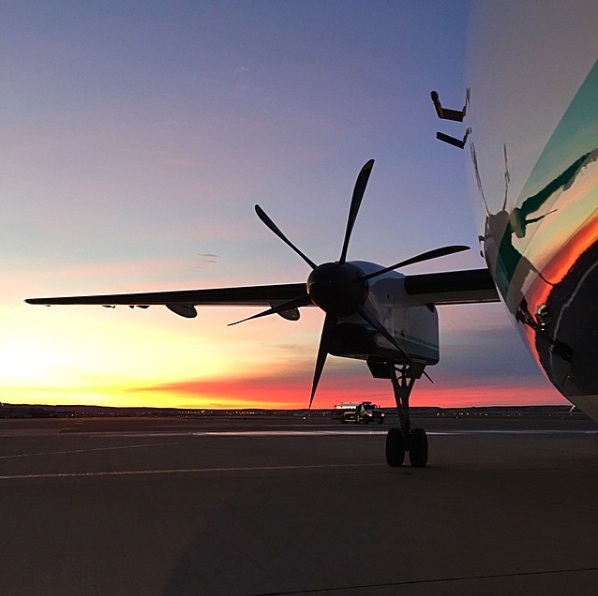
This week, I am thinking about endings. And tomorrow morning, when I settle into my seat on the Boeing 737 bound for the only place I’ve truly ever considered home, I will exhale. I will take some much-needed time. Time to reflect on all that has happened. Time to grieve all that has ended. Time to swim in the sea, time to breathe in the salt air. Time to hug people that I love. And time to listen to what life has been teaching me over these last crazy, chaotic, jolting few months, so that in stillness, I can ask myself that big, looming question, “what’s next?”

Until next time, friends.

(Photo credit:  Instagram.com/AlaskaAir)

Alaska Air

Chasing happy.

Miranda: When was the last time you were happy?

Samantha: Six months ago.

Miranda: I think that’s normal for L.A.

Yes, I really did just quote the Sex and the City movie. I couldn’t help myself. Ever since it was on HBO some night a few weeks ago when I was up way too late and unable to sleep, I haven’t been able to get that scene out of my head. It’s the scene where all the girls have gathered for Charlotte’s baby shower and they’re grilling an obviously unhappy Samantha about her new life in Los Angeles. The bit of dialogue quoted above made me laugh out loud. In a, it’s funny because it’s true, kind of way.

In just a couple of weeks, I will mark sixteen years of living in Los Angeles (minus a scant five-month study abroad semester in London in the early 2000s). That’s longer than I’ve lived anywhere. And in that time, I’ve met and known and befriended a great number of people in this sprawling metropolis – some of whom still call L.A. home and some of whom have long since moved on to other places. And of my friends who still live here – other than a handful of exceptionally grounded folks who seem to have it all figured out – there aren’t many that I would describe as happy.

IMG_4634

Don’t get me wrong: this isn’t some hit piece on L.A., nor is it an attempt to legitimize the swarms of stereotypes that exist about this fair city – the suntans and silicone, the hot cars and hot spots, the fame seekers and the fabulously wealthy, the beautiful and the damned. No, this isn’t that type of essay. Nor is this essay even about L.A., not really. L.A. is just the place where I happen to live and therefore it’s a lens through which I view the world.

But it is my lens, and through that lens I see constant seeking and striving, struggling and searching. I see good people who are making the best of things, people who believe that better days are ahead but just can’t quite seem to get there, people whose real, unfiltered lives rarely match the glossy surfaces of their Instagram feeds. And it has left me wondering: is this sort of slow, seeping sense of dissatisfaction an L.A. thing, or is it more pervasive? Is everyone, everywhere suffering from an epidemic of, I’m not as happy as I want to be?

My obsession with the subject of happiness began nearly three years ago, when a series of tragic events left me – someone who, as a girl, my Dad teasingly called “Pollyanna” – wondering if I would ever feel joy again. Prior to this major life shift, I’d never really thought about whether or not I was happy. I moved through my days with relative ease, eyes ever on the horizon, mind focused on the next thing. If I’m honest, I didn’t do a whole lot of self-examination or press myself to answer the difficult questions. I kept going. I was fine.

Except I wasn’t. It took pain and tumult to unearth the truth. I had been living with the same sort of silent malaise that I now recognize all around me, but I had been too passive, too complacent, to do anything about it. All the while the question nagged, Is this all there is?

But recognizing that there was a problem wasn’t enough to present a solution. In fact, it got much worse before it began to get better. My lowest point came last summer, when more than once I collapsed on my bathroom floor, sobbing, unable to get up for what felt like hours. In fits of desperation, I scribbled inspirational quotes on the pages of “get well soon” cards and mailed them to myself. And I documented it all (well, not all) in blog posts that prompted worried (read: frantic) phone calls from friends.

A year later, I still wouldn’t describe myself as “happy,” but when I look back on those dark days, I do have to give myself credit for how far I’ve come. It was impossible for me to have any sense of perspective when I was “in it,” but with time and distance I can see that I really was growing and changing all along.

IMG_4630

For nearly three years I have been chasing this elusive thing called “happy.” Along the way, I’ve tried many different tactics in order to feel better. I’ve consulted palm and tarot readers, astrologers and spiritual counselors. I’ve traveled extensively:  to Europe, to my childhood home of Alaska, and all up and down the Western United States. I’ve talked to friends. I’ve gone into therapy. I’ve worked out obsessively, and then not at all. I threw myself into my writing. I became a mentor to a teenage girl. And I kept going, even when I didn’t feel like it. I kept going, because I didn’t feel like it.

This may seem counterintuitive, but some of the darkest moments of my life have also been bookended by some of the most joyful ones. A pair of Orca whales breaking the surface of the water in graceful arcs while I pressed my nose to the window of a ferryboat. Sitting in the warm, inviting kitchen of a friend’s home in London, drinking wine and discussing politics. Seeking refuge from a rare New Orleans ice storm in a small jazz club with my sisters while the rest of the city remained shuttered indoors. Watching the sunset settle over the ocean from the window of an open air trolley car coasting along Pacific Coast Highway, with nothing to do or nowhere to be except right there.

I think that what all these singular “happy” moments have in common is their sense of hope, their sense of possibility. A feeling they evoked, that, in the words of Shel Silverstein, “Anything can happen. Anything can be.”

Conversely, the worst, most miserable moments of my life didn’t impact me so intensely simply because I felt sad or broken, but because I felt powerless to change those feelings. I was helpless, stuck, and I couldn’t see the way out. The darkness is most unbearable when it appears unceasing, when we can’t fathom the possibility of light ever breaking through.

After nearly three years of “chasing happy,” I certainly don’t have it all figured out. But I have learned some things. I’ve learned that I feel better extending a helping hand to others than I do ruminating about my problems. I feel better using my own life as a yard stick to measure my progress, rather than comparing my achievements to someone else’s.  To that end, I feel better when I limit my time on social media.  I feel better being honest instead of making everything OK; better telling uncomfortable truths than biting my tongue. I feel better writing than not writing, better creating than not creating.  I feel better going for a run than I do sitting on my couch. I feel better moving forward than I do standing still. And I feel better trusting in the hard-won knowledge that whatever dark clouds may gather in the skies above, that they too, will pass.

Until next time, friends.

FullSizeRender[2]

Owning it.

“You own everything that happened to you.  Tell your stories.  If people wanted you to write warmly about them, they should have behaved better.”

– Anne Lamott, Bird by Bird:  Some Instructions on Writing and Life

Burned sign

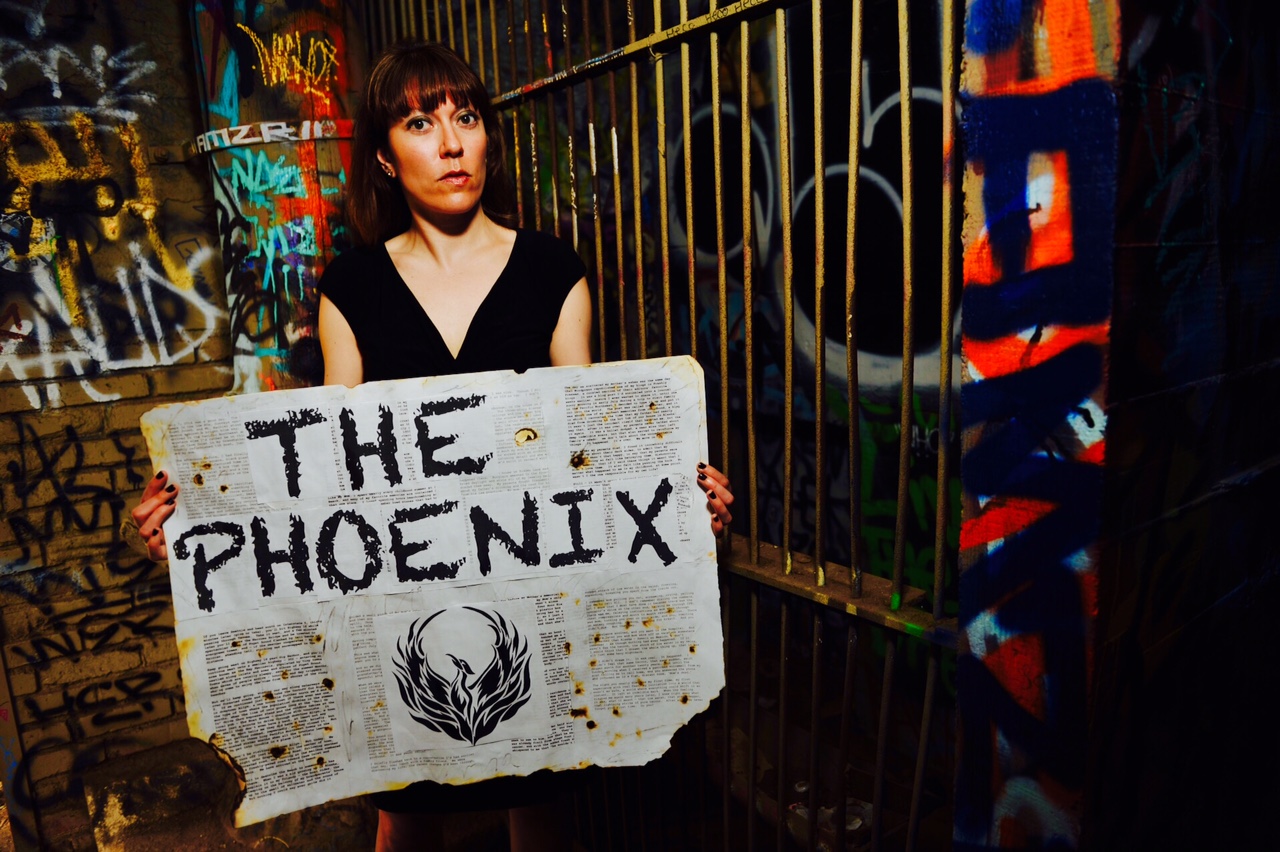
Four months ago, I started work on a new play that is unlike anything I’ve ever done before. It’s a solo performance workshop called Bare Naked Angels, conceived and directed by my friend Stacy Ann Raposa. The workshop is kept to a small group: our cast, which started as eight people and became seven, is on the larger side.

In the beginning, using readings and exercises from Julia Cameron’s “The Artist’s Way” to guide us, we each brought in weekly writing assignments to read in front of the group. As the weeks went on, the seemingly pointless ramblings about our day-to-day experiences or random childhood memories evolved into discussions about our hopes and dreams, the events that shaped our lives, and the nature of our identities. As we settled on the stories we wanted to tell on stage in front of an audience, we each emerged with a strong point of view about how we see the world.

BNA recolored group shot

I began this process with a clear idea of the story I wanted to tell. These last few years, my life has contained an inordinate amount of darkness. I didn’t want to dwell on that. I wanted to tell a story that was uplifting, that was about survival, about hope triumphing over despair. I wanted to tell a story that was more beautiful than what I’d been living. A story that I would want to read, that I would want to hear.

Like many things in life, the place I ended up arriving at was far different than the one I had envisioned when I began this journey. It turned out that I wasn’t so much writing the story as the story was writing me. And gradually, I learned to submit to that process, to let my words come out the way they wanted to, the way they needed to. Without judging them, without censoring myself, without worrying what other people would think. To just let it be what it was: the truth.

When the writing was done, Stacy (our director), took the seven intimate, honest, and (dare I say) incredibly brave stories written by our cast, chopped them up, and wove them together to create something beautiful: an achingly true script that is essentially a solo performance/ensemble piece hybrid. With only three days left until the show’s opening night, I’m equal parts exhilarated and exhausted.

BNA Publicity Shot recolored

To be honest, I have no idea how audiences are going to receive this show. I hope they love it as much as I do, but there’s really no way to tell with something like this. There is certainly nothing “escapist” about Bare Naked Angels. It puts real life in your face and dares you not to look away. Yet it’s also full of so many sweet, profound, heartbreakingly human moments. Ultimately, like the story I wanted to tell – and which, in large part, I think I did – I believe that this show will leave audiences feeling hopeful and with a greater connection to their own lives.

So here we go. It’s time to jump into the deep end of the pool and hope I can swim. Wish me luck.

P.S. – If you’re in the Los Angeles area and you want to come see this thing go down, I would love to have you. The flyer is below, and everything else you need to know can be found at www.fringetheatreco.com

Thanks for reading, friends.  I promise to let you know how it goes.

angels_unabated_poster

Roll the dice.

The other day, I felt like I couldn’t breathe. I was sitting at my desk, dutifully checking off items on my to-do list, staring vacantly at my computer screen, wishing I were somewhere else. I had awoken extra early to put the finishing touches on a new piece for this blog – something about the importance of focus – but as I read it and read it again, I realized I couldn’t publish it. It felt dishonest, like I was trying too hard to sound like someone else. Someone who – unlike me – had their sh*t together.

And that’s when the existential dread set in. Who am I, anyway? What could I possibly say that’s important, or that will make any difference? Who cares?

The what’s the point of it all feeling rose quickly in my chest and caught in the back of my throat, a dull nausea spinning in my stomach, and I knew I had to get out. Before I could let the to-do list stop me, I slammed my laptop shut, laced up my beat-up running shoes, grabbed my keys and left. I got in my car and drove westward, toward the coast.

I live only seven miles from the ocean, but it’s staggering how little I make time in my schedule to go and see it. Throughout my life, the sea has always had a powerful effect on me. The sense of calm and peace it instills is so profound that I know in my bones I could never live far away from a body of water. When times are toughest – when I’m sad or lost or feel like I’m about to crawl out of my skin – that’s when I crave the sea the most.

IMG_4359


I parked my car on San Vicente. Putting my ear buds in, I trudged down the Santa Monica Stairs and then back up the incline that leads to Ocean Avenue and Palisades Park. I jogged through the park, marveling at the dense marine layer still blanketing the coast, even though just a handful of miles inland, my little stucco bungalow was already baking in the 11 a.m. summer sun. The fog shrouding the sea was so thick and white, you couldn’t tell where the horizon ended and the sea began, casting a hazy sort of magic over Palisades Park. I breathed in that fog, the sea, and almost immediately I felt soothed, better.

I let my brain race freely as I jogged along. When I got to the construction zone at the California Incline, I turned around and headed for the entrance to the steep set of stairs at the Montana Beach Overlook. I descended the sandy wooden steps toward Pacific Coast Highway, dodging beachgoers carrying bikes and surfboards. And then back up I went, the burning in my calves intensifying as I climbed faster and faster. Descend and climb. Descend and climb. I pushed myself again and again, the fatigue in my body finally allowing my tired brain to relax and settle into something that felt less like chaotic noise and more like calm, focused thoughts.

As I climbed, I thought about my Dad. Father’s Day had just passed, and his birthday was coming up. If he could see me now, what would he think? I didn’t have to wonder about it, I already knew. He’d tell me that I needed to stop complaining about my “problems” and get to work. Throughout my life, whenever I was slacking off or not doing all I could, I’d dread the inevitable grilling from Dad. He’d always unearth the truth in his lawyerly fashion: straight to the heart of the matter. “Well if you know better Sar, then why don’t you do better?”

IMG_4094

The truth is, my recent lack of motivation isn’t rooted in laziness, or lack of ambition. It’s rooted in fear. I’ve been experiencing what you might call a crisis of confidence: blocked in my writing, hating all of my creative ideas, feeling hopelessly stuck and worried that everything I’ve been working so hard on is no good and a waste of my time.

Time. Whenever this “what’s the point of it all?” paralysis sets in, it always comes back to that question of time. What am I doing with it? Am I making the most of it? Is activity A, B, or C really worth my time? I’m ever aware of how precious it is, ever fearful of it slipping through my fingers, even as it does that very thing.

Plenty of things we invest our time in don’t work out. People die. Relationships fail. Jobs end. Does that mean they weren’t worth our time? I don’t think so. It’s all a part of life, experiences we need to have so that we can learn and grow and (hopefully) improve. I suppose that nothing about how we choose to spend our time can really be a waste unless we willfully choose to waste it.

Is that what I’ve been doing? Willfully wasting my time indulging in my own neuroses? What would Dad say? He was an “all in” kind of guy. He wouldn’t let fear or doubt stop him. And as I thought about Dad, I remembered a poem written by Charles Bukowski. It’s called “Roll the Dice” and it’s something I’ve loved for years, returning to it again and again whenever I’ve needed a swift kick in the ass. Here it is:

if you’re going to try, go all the

way.

otherwise, don’t even start.

 if you’re going to try, go all the

way.

this could mean losing girlfriends,

wives, relatives, jobs and

maybe your mind.

go all the way.

it could mean not eating for 3 or 4 days.

it could mean freezing on a

park bench.

it could mean jail,

it could mean derision,

mockery,

isolation.

isolation is the gift,

all the others are a test of your

endurance, of

how much you really want to

do it.

and you’ll do it

despite rejection and the worst odds

and it will be better than

anything else

you can imagine.

 if you’re going to try,

go all the way.

there is no other feeling like

that.

you will be alone with the gods

and the nights will flame with

fire.

do it, do it, do it.

do it.

all the way

all the way.

you will ride life straight to

perfect laughter, its

the only good fight

there is.

I left the beach and went home, utterly exhausted. Later, when I re-read those words by Bukowski, I thought about how my Dad spent much of his life as the living embodiment of them. I thought about how I wanted to be more like that. And I thought about how the best way I could honor my father as I approached his birthday was to stop hesitating, stop moving through my life with so much doubt and uncertainty, and simply “roll the dice.”

IMG_3171

Easier said than done, but maybe my first step is to spend a lot more time climbing those stairs, breathing in the ocean, clearing out the noise.

Until next time, friends.

Going dark.

I haven’t published a new post on this blog in almost three weeks, which feels like a really long time. In truth, May was a difficult month for me. It had some lovely bright spots – like a trip to the San Francisco Bay Area to visit friends – but overall it was challenging, leaving me exhausted and drained.

I spent a lot of the month of May writing about my mother, both autobiographically (a theater piece I’m working on that will premiere in July) and fictionally (exploring the mother/daughter relationship that’s at the heart of my screenplay). All of this recent personal archaeology, combined with the fact that Mother’s Day and my Mom’s birthday are both contained within the month of May, left me feeling emotional and raw – like an exposed nerve – these last few weeks.

I tried to write my way through these feelings – I often do – but found myself hitting a wall. I started writing several potential blog posts, but abandoned them all halfway through. Sometimes what I end up writing turns out to be so dark that I don’t want to share it. Sometimes I catch myself falling victim to a “If you can’t say anything nice, don’t say anything at all” form of self-censorship. And sometimes I just want my life to look better to the outside world than it actually feels, to me. I guess all of these things are my own personal stumbling blocks.

As it can sometimes happen in this crazy life, it took something of a breakdown in order for me to experience a break through, or at least, a moment of clarity. At my lowest point, I was sitting on my therapist’s couch, crying because I was feeling sad and hadn’t been able to shake the feeling for several days. I had thought I was finally done with the waves of grief, but here they were again, rearing their ugly heads with a vengeance. “I am so tired of this,” I wailed. “When am I going to feel better?”

“What does better mean?” she asked, in that annoying way that therapists can ask questions you don’t have the answers to. And we sat in silence while I pondered what in the hell exactly I did mean. “I just wish it were easier to be happy,” I said, finally. “Like it used to be.”

“I feel like I’m doing everything I can think of,” I continued. “I exercise and I volunteer and I keep a gratitude journal and I practice self care. And,” I said, indicating, my therapist, “I’m here with you. Which is a big deal for me.”

“Yes,” she agreed. “You’re good at doing the right things. But what if, sometimes, there’s nothing you can do? What if, sometimes, you can’t fix it? What if you just have to let it be what it is?”

Nothing I can do? I was speechless. I am not used to doing nothing. It makes me feel weak and ineffective and powerless. But as I sat there, silently, feeling sorry for myself, I wondered if she wasn’t right. Have I been trying too hard, pushing too stubbornly to be someone and something I’m not?

Going dark scares me. It’s a slippery slope, and after watching my mother slide into blackness and never come out, I am terrified that the same thing could happen to me. Perhaps that’s why I fight so hard against the dark days when they come. But I have to admit, not only is denying my sadness not working, but it’s wearing me out. What if I could learn to simply sit with those bad days, to embrace them, even? What if I could do it without judging myself, without worrying that others will judge me, or distance themselves from me because I’m too difficult to be around? What if I could allow myself to be sad when I’m feeling sad without fearing that those feelings will swallow me?

Maybe going dark – on occasion – isn’t so bad. Maybe it’s just like the weather. Some days it rains. Some days the sky is clear and blue. And no matter how bad the storm, it will always, eventually, lift. And as anyone who has ever enjoyed hiking in the city I live in – Los Angeles – will tell you, the best time to ascend a mountain is the day after a downpour, when all the smog has blown out, the air is clear and beautiful, and you can see for miles, all the way down to the ocean.

Until next time, friends.

Words: a Love Story.

I’ve been writing my whole life, but until recently I never really considered myself a writer. Not like that. Writing was just something that I did. Whether they were high school essays, papers for a college journalism class, or the plays and short films I wrote when I first started acting, writing was always just something that came naturally and was fun to do, but nothing I ever took too seriously.

That all started to shift about three years ago. I’d been writing Extra Dry Martini for just a couple of months – something I started doing for fun – when my entire life fell apart. I’ve written in great detail about loss on this blog and I don’t feel the need to rehash it, but suffice it to say that the spring of 2012 through the spring of 2013 was a very difficult year for me. A very difficult year, the ramifications of which are still reverberating throughout my now very different life. When I finally came up for air and felt brave enough to write about it, I published a piece on this blog about my experiences entitled The Lost Year. And from there on out, my writing was different.

So it was that writing became less of a hobby and more of a lifeline. In the last year and a half, writing has been not only my most reliable creative outlet, but it has been my therapy. I would no sooner give it up than I would give up breathing, and in fact, I’ve often wondered if I were to give it up, if I would still be able to go on breathing.

When I feel lost or adrift, getting all those thoughts and feelings down on the page is sometimes the only thing that brings any relief. And while I don’t really believe that you can “get it all out,” there is something liberating about being able to wrap my mind around a moment, around pain or sorrow, around joy, around love, and to articulate it in such a way that it’s no longer a swirl of chaos in my brain, but something more ordered and easier to understand. Once on the page, with the words and thoughts at a slightly safer distance, I can read them with a measure of objectivity and think, maybe this thing has a little less power to hurt me than it used to.

I write out of a burning desire to transform the sad, empty spaces within me into art and in doing so, transcend the parts of me that still feel broken. And while I cherish the time I’ve spent absorbed in thought putting pen to paper or fingers to keyboard, I sometimes wonder if all the hours I’ve invested in crafting pretty sentences have left me less able than before to say the things that need to be said when it comes to face to face interaction with real, live people.

At this moment, I find myself juggling two projects that will soon bridge that gap: a gap between the solitude I’ve been spending in my own little creative laboratory and the big, bad outside world. The first project is a play. In July, I’m going to stand on a stage and talk about some of the very personal, very vulnerable things I’ve been writing about on this blog as part of a solo performance workshop called (appropriately) Barenaked Angels. For the first time, I’m going to say some of the things I’ve been writing down out loud, in front of an audience. Yikes.

The second project is my screenplay, a project and process I’ve detailed in earlier posts like Putting off tomorrow and Little steps. Big steps. First steps. As I continue to work through the second draft and push toward a looming deadline to hand over scripts to actors for the first table read, I am discovering more and more that the parts of the story that aren’t yet working are the parts where I haven’t delved deeply enough into the main character’s hopes, dreams, and flaws. In other words, it’s an autobiographical story without quite enough autobiography in it.

Words are seductive. There is something exquisitely satisfying about capturing a moment on paper and thinking, yes, that’s exactly what happened, how I felt about it, and why it mattered. Words have an incredible capacity to illuminate a life. But in the end, words are not life, and one cannot live by words alone. I’m so grateful for what writing has given me – for the way it has sheltered me through pain and has allowed me to connect with the hearts and minds of other writers through this blog. I will always, always be writing. But the writer’s life is also about finding balance. A writer needs to experience the world in order to write about it, and I haven’t been doing nearly enough of that lately. So now it’s time for me to take the next step: to take the lessons I’ve learned and not just write better, but live better too.

Until next time, friends.

Moments.

It’s an early evening in late April in Los Angeles. I’ve been running in La Cienega Park, around and around that dusty dirt track, spurred on by pop music pulsating through my ear buds and the excitement of a little league baseball game nearby. The sounds that echo through the spring evening – the crack of the bat smacking the baseball and launching it into the outfield, children’s voices cheering, parents clapping – give me an extra spark of energy to keep going, to keep running, to keep pushing my body forward.

FullSizeRender

I finish my last lap and leave the track. Tired and sweaty, I run across Olympic Boulevard and turn down Alfred Street, slowing to a jog and then to a fast walk as I enter one of my favorite enclaves in this historic South Carthay neighborhood. iTunes skips to the next song – The Lady is a Tramp – and suddenly everything slows down. As Sinatra croons into my ear buds, I take in the soft blue watercolor sky melting into pale yellow, the amber rays of the waning sun casting their golden glow across the tiled rooftops of stately Spanish style homes, the statuesque palms, the immaculate gardens carefully landscaped with delicately blooming roses and cactus flowers. I feel my steps getting easier, almost as though I’m gliding down the sidewalk, and the air rises in my chest and catches somewhere near the back of my throat in a sharp tingle. Water springs to my eyes and though I don’t cry, I am overwhelmed with emotion as I realize that everything in this moment is perfect. It’s as though I’ve been transported back to a Los Angeles of 60 or 70 years ago, frozen in time, nestled away on this perfect street, at the perfect time of day, with the perfect song creating my soundtrack.

I want to hold on to this moment – and how I feel in it – forever, but even as I’m aware of it, I know it’s almost gone. I think about my Dad. There’s a word he would have used to describe this type of evening: halcyon. It means peaceful, tranquil, carefree. In this one moment, I am all of those things. And I’m also grateful: grateful for the memory of a word that comes to me like magic at a moment when time seems to stand still.

FullSizeRender[1]

And just like that, traffic starts buzzing down the street, the sky grows darker as early evening inches toward night, and the moment is gone. And I head home.

For most of my life, I’ve been moving too fast to notice moments like these. Always in a hurry to get to the next big thing. Ever looking forward to the next exciting date on my calendar, the next time I’d get on a plane to travel somewhere new, the next creative project on the horizon, the next vacation or holiday. Ever looking forward as I skipped over all the “boring” day-to-day moments in the process.

And then when my life started to unravel and people I loved started getting sick and dying, all I wanted was to be on the other side of it. I wanted so badly for things to be the way they used to be, to feel “normal” again, that I threw myself at life as hard as I could. I pushed myself to “get through it” by working hard and setting ambitious goals. My intentions were good – realizing how short and precious life was, I was driven by an internal fire to make the most of it – but my efforts were futile. I learned the hard way that life unfolds as it will, despite my stubborn refusal to accept what it had in store for me, and despite all of my best laid plans.

FullSizeRender[2]

I’m a control freak by nature, and learning to let go has been difficult for me. But little by little, I’m getting there. I’ve started paying closer attention to the here and now, and I’ve become more comfortable living there. And I’ve started realizing the truth in these words from Julia Cameron’s beautiful book “The Artist’s Way:”

It may be different for others, but pain is what it took to teach me to pay attention. In times of pain, when the future is too terrifying to contemplate and the past too painful to remember, I have learned to pay attention to right now. The precise moment I was in was always the only safe place for me. Each moment, taken alone, was always bearable. In the exact now, we are all, always, all right.

I am no longer in a place where the future is too terrifying to contemplate, and the past, while painful, is getting easier for me to remember. Yet it is still the present moment, most of the time, where I feel most OK. There’s a freedom that comes from not trying so hard, from not pushing so desperately to make my life conform to some idea of what I thought it was supposed to be, and instead, to let it be what it is. I still crave adventure and travel to far-flung locales. I still aim my arrow toward the challenge of tackling the loftiest goals. I still want the big moments in life, with all of their excitement and (sometimes) heartbreak. But in between all of those things, there are many, many smaller things: the small moments that make up a day, and that make up a life. Moments like catching the perfect sunset at the perfect time of day in the perfect place to witness it.

Those little moments are worth holding on to. Those little moments – for the moment – are where my happiness resides.

Until next time, friends.

FullSizeRender[3]


Blog at WordPress.com.